
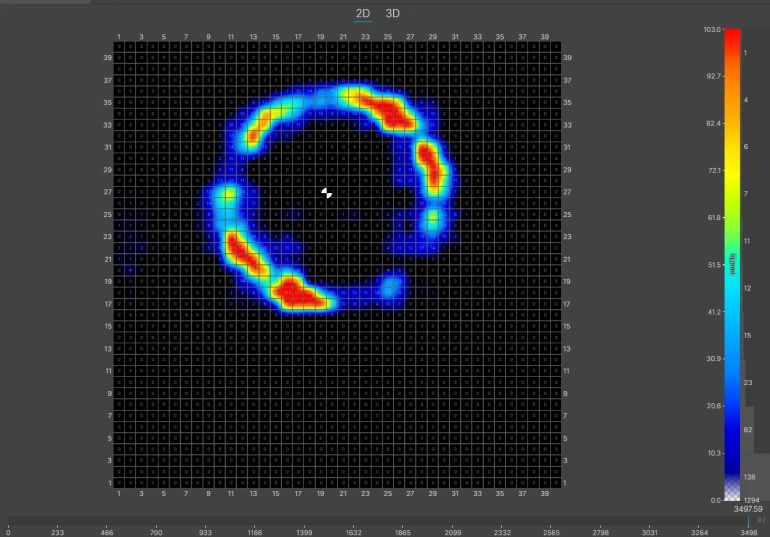

Coil spring performance is strongly influenced by how load is transferred between the spring and its supporting surfaces. Different end-coil design strategies—such as squared ends, angled cuts, or modified final coils—can significantly affect contact area, load balance, and long-term durability.
Accurately measuring pressure distribution at the spring interface allows engineers to objectively compare these design approaches under realistic loading conditions.
Design Challenge
Determine the pressure distribution between a coil spring and its support that improves performance, extends service life, and ensures balanced load transfer.
Our Approach
Pressure mapping solutions enable detailed evaluation of contact pressure between coil springs and their mating surfaces. Thin, minimally intrusive pressure sensors can be positioned beneath the spring coils to capture contact area and pressure changes as different loads are applied.
Pressure data can be visualized using intuitive 2D and 3D maps, making it possible to compare coil spring designs and end-coil geometries during simulated operating conditions.
Sensor solutions are available in multiple shapes and sizes, are reusable, and provide accurate, repeatable contact pressure measurements. Test configurations can be adapted to different spring geometries, load ranges, and development objectives, supporting engineers throughout design, validation, and performance testing phases.
Coil Spring Pressure Measurement Applications
- Research, design, and development
- Comparison of small and large diameter coil designs
- Evaluation of load balance around the coil
- Life cycle and durability assessment
- Performance testing
- Quality assurance and consistency checks
Benefits of Pressure Mapping in Coil Spring Design
- Replace assumptions with quantitative pressure and contact data
- Improve wear prediction and linear stability assessment
- Support optimization of spring shape, thickness, and material selection
 Made in Italy