
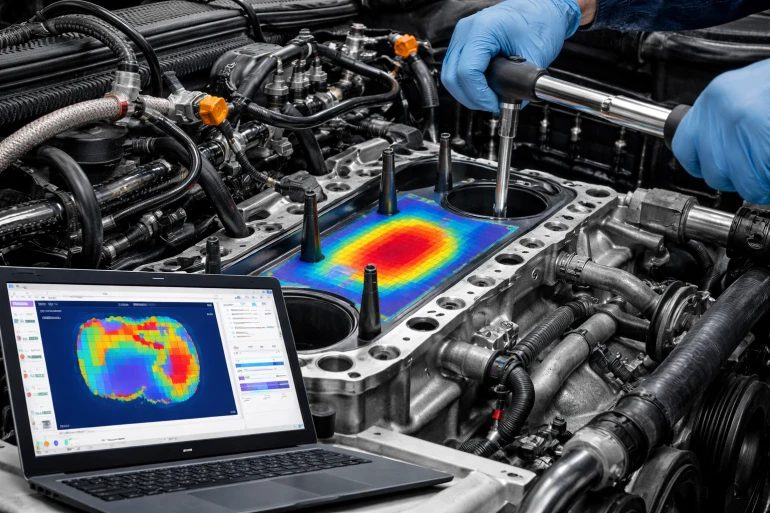

Accurate pressure and force measurement is essential in gasket research and design. Understanding how pressure is distributed across a gasket ensures seal integrity, supports proper material selection, verifies real-world performance, and contributes to overall system safety and efficiency.
Advanced pressure measurement solutions enable engineers to evaluate dynamic forces and contact pressures around virtually any type of gasket, supporting data-driven decisions throughout development and testing.
Common Gasket Materials in Pressure-Sensitive Applications
Pressure mapping plays a key role in evaluating performance across a wide range of gasket materials:
- Rubber – Flexible and chemically resistant, ideal for low-pressure applications
- PTFE (Teflon) – Excellent chemical resistance and high-temperature capability
- Graphite – Suitable for high-temperature and high-pressure environments
- Metallic – Designed for extreme pressure and temperature conditions
- Non-Asbestos Fiber – Safe alternative with strong chemical resistance
- Cork – Highly compressible, suitable for irregular surfaces and low flange pressures
Application Example: Engine Gasket Evaluation
Engine efficiency and reliability depend on maintaining a consistent seal throughout the combustion cycle. Variables such as block and head geometry, fasteners, torque values, lubrication, and gasket design can significantly affect sealing performance.
Thin, flexible pressure sensors can be placed within or around engine gaskets, seals, and fasteners to capture detailed pressure distribution data under real operating conditions.
This enables engineers to measure dynamic load changes during assembly, operation, vibration, and thermal cycling, validating designs and correlating results with simulation and FEA models.
Pressure mapping can also support controlled engine testing to evaluate how seal pressures respond to vibration, internal pressurization, and mechanical loading.
Gasket Seal Pressure Measurement Applications
- Identification of uneven pressure distribution and poor seal quality
- Before-and-after comparison of design or assembly adjustments
- Reliability and durability testing
- Design verification and validation
Benefits of Pressure Mapping
- Objective data for improved gasket and seal design
- Reduced product waste and rework
- Improved manufacturing consistency and yield
- Safer and more reliable sealing solutions
 Made in Italy