
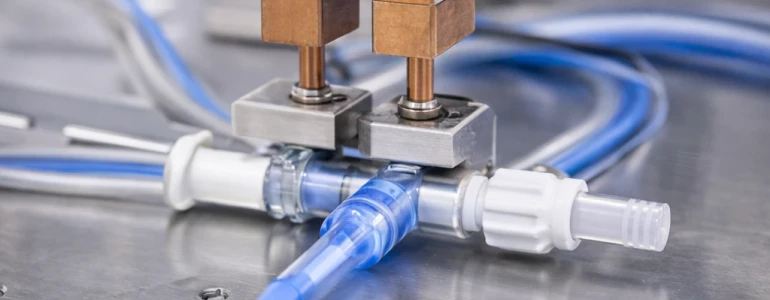

Challenge: A manufacturer assembling medical devices through a pressure welding process needed to verify the applied pressure and load during production.
Solution: By implementing the Tactilus® system, the customer obtained accurate, real-time pressure data directly from the manufacturing process—insight that had previously been unavailable. This enabled fine-tuning and calibration of the system, resulting in more consistent and reliable production quality.
Why Pressure Measurement is Critical in Ultrasonic Welding
Proper Energy Transfer
- Pressure ensures proper contact between parts and the welding horn (sonotrode).
- Insufficient pressure leads to poor energy transfer and weak or incomplete welds.
- Excessive pressure can cause deformation, energy loss, or surface damage.
Weld Quality and Strength
- Pressure must be balanced with vibration amplitude and duration.
- Accurate control prevents defects such as flash, voids, and internal cracks.
- Ensures strong, reliable welds without material damage.
Repeatability and Process Control
- Medical device manufacturing requires tight tolerances and consistent weld quality.
- Controlled pressure ensures uniform welds across production batches.
- Supports compliance with standards such as FDA and ISO 13485.
Avoiding Overweld or Cold Weld
- Overweld (too much pressure or time) may cause part collapse or surface damage.
- Cold weld (too little pressure or time) results in weak joints.
- Pressure must be adjusted according to material properties, geometry, and weld design.
Real-World Example: Catheter Manufacturing
In catheter production, soft plastic tubing is welded to hubs or connectors. Incorrect pressure levels can lead to serious defects:
- Too high: Tubing deformation or collapse, blocking fluid flow.
- Too low: Incomplete bonding, causing leaks or detachment.
Maintaining controlled pressure—combined with correct amplitude and timing—ensures smooth, clean, and leak-proof joints, critical for patient safety and device performance.
Pressure Measurement in Resistance Welding
Precise pressure measurement is essential in resistance welding, widely used to join small components such as fine wires, foils, and terminals in medical devices.
Typical applications include:
- Pacemaker leads
- Catheter guide wires
- Sensor connections
- Microelectronic terminals
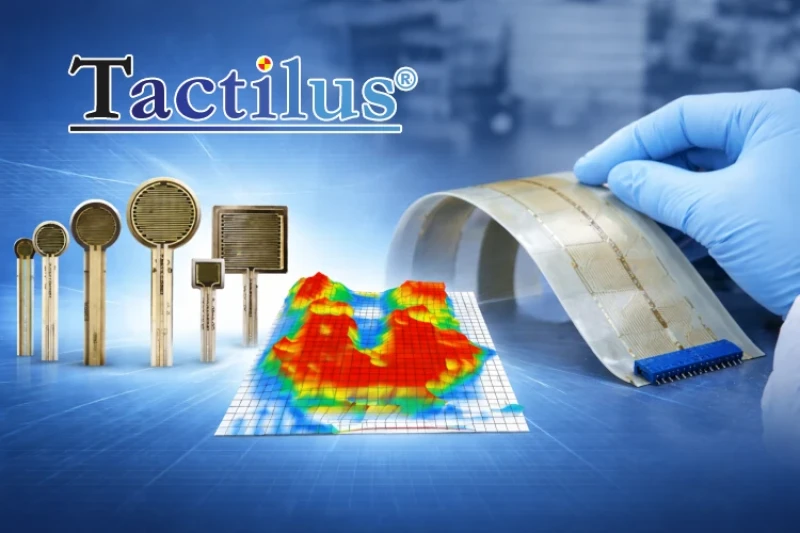
Tactilus® pressure mapping sensors can be positioned on either side of an assembly mechanism to ensure devices are consistently built to specification.
Customizable solutions are available across multiple pressure ranges. Systems are reusable, deliver highly accurate readings, and are supported by expert sales and engineering teams to meet specific manufacturing requirements.
 Made in Italy