
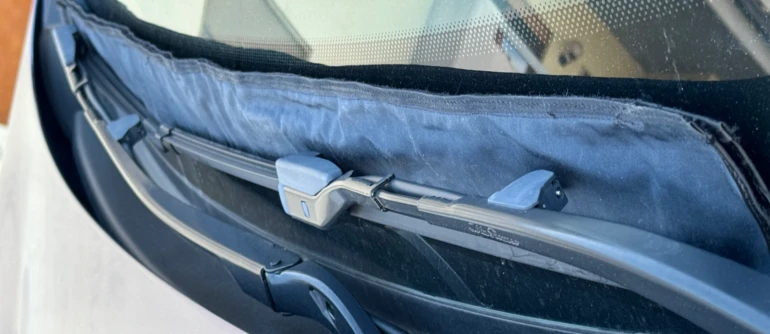

Measure a wiper blade’s linear force as it is applied to the windshield, capturing the real-time contact area between the blade and glass.
The surface pressure mapping system for windshield wipers captures detailed images and statistical data, showing the real-time contact patch between a car’s wiper blade and windshield. Using Tactilus®, a powerful Windows®-based software toolkit displays high-resolution images of the contact area and highlights irregularities in pressure across the entire blade surface.
Tests can be conducted both in the laboratory and in wind tunnels, providing flexibility for a wide range of experimental setups.
Tactilus® Technology
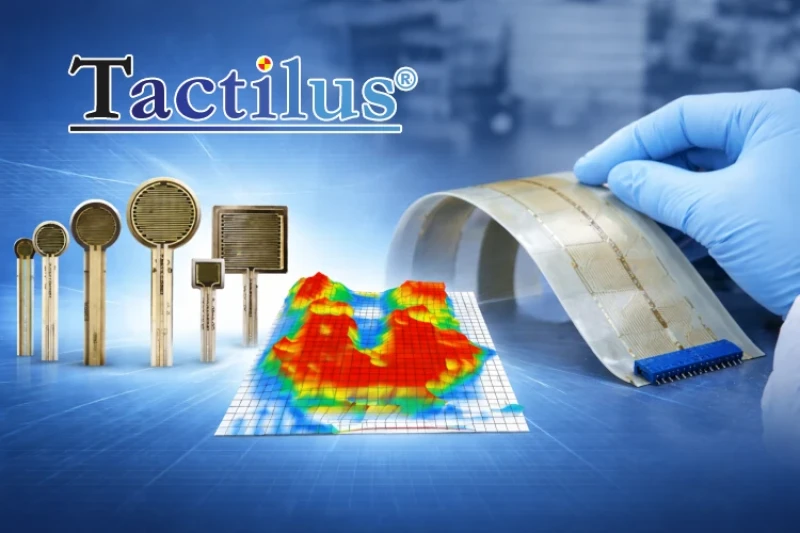
Tactilus® is a matrix-based tactile surface sensor, functioning as an “electronic skin” that records and interprets the distribution and magnitude of pressure between two contacting surfaces.
Each sensor is assembled to precise tolerances, individually calibrated, and serialized to ensure reliable, accurate measurements.
The modular system design supports portability, easy expansion, and simultaneous data collection from up to four separate sensor pads. Sophisticated algorithms distinguish signal from noise, while advanced electronic shielding maximizes immunity to interference from temperature, humidity, and electrical noise.
Custom Wiper Blade Sensor Strip
A custom, thin, flexible sensor strip contains 100+ individual pressure sensors arranged along its length. Combined with sensitive, portable electronics and software, the system accurately measures the pressure profile at the wiper blade–windshield interface under a variety of operating conditions.
Wiper Blade Pressure & Force Measurement Applications
- Measure blade performance
- Identify uneven pressures
- Before-and-after adjustment comparison
- Reliability testing
- Design verification testing
Benefits of Pressure and Force Measurement
- Improve design
- Eliminate the need for costly fixtures formerly used to model windscreens
- Competitive benchmarking
Technical Parameters & Sensor Specifications
- Repeatability: ± 2%
- Repeatability error: ± 3%
- Technology: Piezoresistive fabric
- Pressure Range: 0 – 142 PSI (0 – 10 kg/cm²)
- Grid Size: 1 × 64 (standard length)
- Sensing Points: 64 (standard length)
- Sensor Dimensions: 0.4” × 32” (1 cm × 82 cm), length customizable
- Scan Speed: 50 Hz
- Spatial Resolution: 0.4” (9.35 mm)
- Thickness: 39 mils (1 mm)
- Accuracy: ± 10%
 Made in Italy